
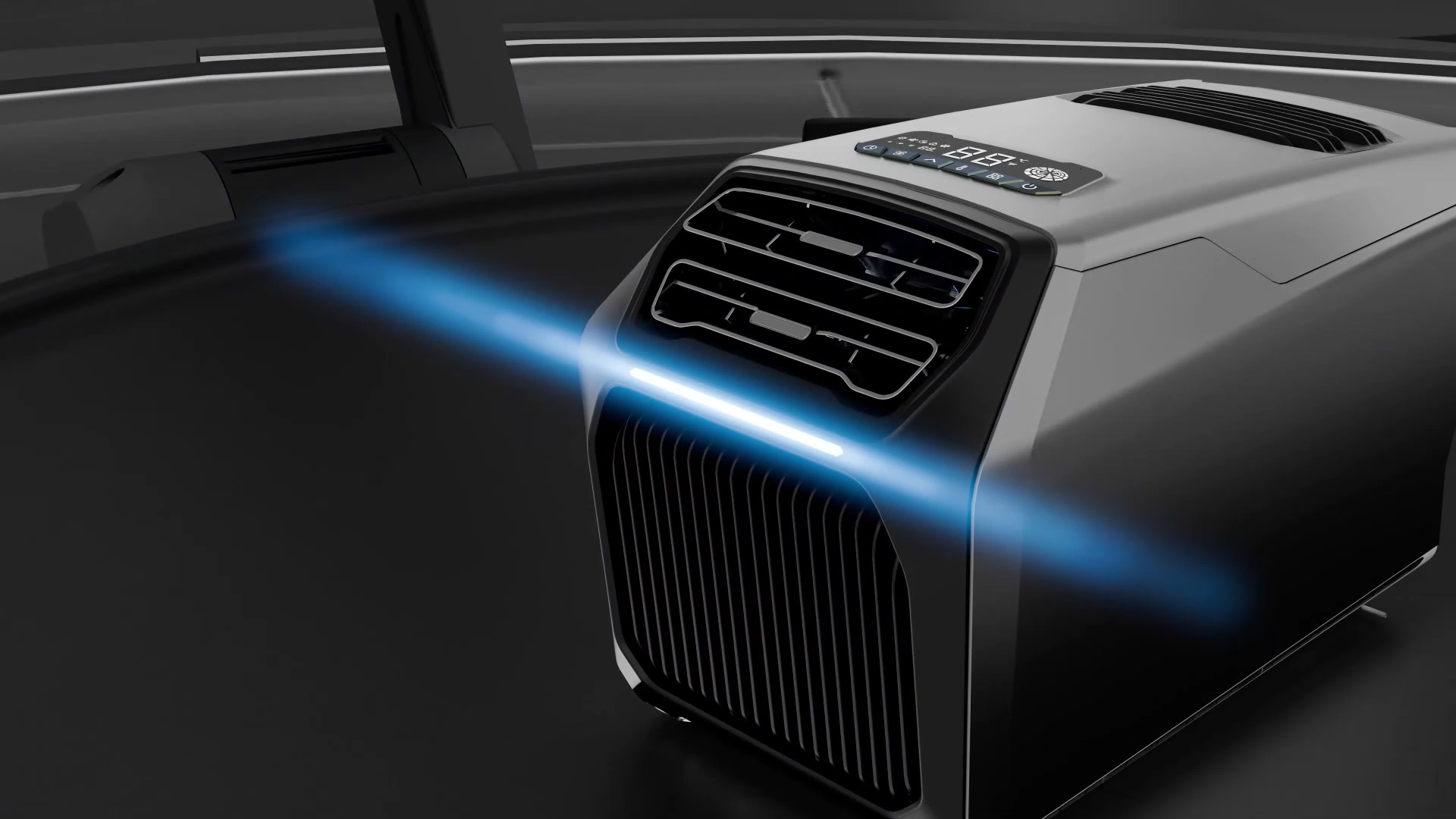
How does home appliance animation clearly explain functions?
First determine whether the audience needs to understand structure, operational flow, component roles, or usage environment. Each shot's visual task should be clear: full product views explain appearance, breakdowns explain relationships, illustrations explain pathways, and scenes explain usage contexts.
The portable air conditioner case demonstrates how these expression methods are combined in a single video. When evaluating a production team, check whether components correspond across different shots, whether pathways are continuous, and whether subtitles and visuals convey the same information.
How do airflow, temperature, or structural illustrations avoid misleading viewers?
Illustrative animation and verified physical simulation are different deliverables. The former is used to explain functional relationships, while the latter requires defined input conditions, models, calculation methods, and verification basis. One cannot claim to have proven temperature, airflow, or energy consumption effects solely based on blue or red streamlines.
The product owner should verify the airflow ducts, component names, structure, and functional descriptions. When performance parameters are involved, use technical materials that the company can publicly disclose and authorize, avoiding the fabrication of data in the video or on the page.
| Materials | Primary Use | Items Requiring Confirmation |
|---|---|---|
| Structural Diagrams and Models | Disassembly and Component Relationships | Public Disclosure Scope, Model Versions, and Part Correspondence |
| Feature Description | Motion and Usage Sequence | Operational Boundaries and Actual Product States |
| Performance Materials | Subtitles and Parameter Expression | Data Sources, Testing Conditions, and Public Authorization |
| Scene Requirements | Characters, Spaces, and Environments | Target Users, Screens, and Distribution Channels |
What video versions do home appliance brands need?
Requirements for aspect ratio, language, subtitles, and information density may vary across launch events, exhibition large screens, e-commerce detail pages, and foreign trade presentations. First list the versions to be delivered, then determine which shots can be shared and which require individual design.
Appearance, color, and structural materials for the same model should also have version records; if the product changes during production, the affected models, shots, and subtitles must be evaluated together.
Frequently Asked Questions
- Can we evaluate the animation without a complete model for home appliances?
- You can first provide product photos, dimensions, functional descriptions, and existing structural materials to assess which models need to be supplemented. It is not possible to accurately reconstruct all internal structures based solely on appearance images; disassembly shots require additional technical basis.
- Can home appliance animations directly promise product performance?
- The animation visuals themselves are not a performance test. Parameters to be displayed should come from verified and authorized public product materials, retaining conditions and scope of application, without presenting visual illustrations as independent verification conclusions.
CONTINUE / Read by question
Connecting works, materials, and requirements.
- 3D Product Animation Production in Foshan and Shunde
- 3D animation for functional office chairs and office furniture
- How to choose a 3D product animation company?
- What determines the production cost of 3D product animations?
- Can 3D product animations be produced without CAD drawings?
- Product animation project: Requirements and delivery checklist
- YUANXIN STUDIO | 3D Product Animation Studio